


“El Correcaminos”

Updated: Jan 6
RATING: 3.5/5 | By Sandro Mairata @smairata/ REFLEKTOR
“The most entertaining Peruvian film of the year.”

“El correcaminos” (The Roadrunner) is the most entertaining Peruvian film of the year and the most original commercial film our country has produced in many years.
A film in the style of “The Fast and the Furious” but with motorcycle taxis, reminiscent of “Wacky Races” (Peruvians know this as “Los autos locos”). What could be better than that? (The reference is now archaic, but anyone over 40 will remember this cartoon show about endless car races with comedic characters such as the villain Dick Dastarly –“Pierre Nodoyuna”– and his dog Muttley –“Patán”–, Penelope Pitstop –“Penélope Glamour”– in her pink car, and so on).
It took Barney Elliott, an American director based in Peru, a decade to bring this film to the screen, and it was worth the wait: a skull-shaped motorcycle taxi with horns, one with a jungle vibe, and so on. Even at its most nonsensical, this is a delightful premiere that deserves to be celebrated.
There are flaws, that is undeniable. One is that several character storylines were cut during

editing, leaving them unfinished in the final product, with an inexplicable or incomplete presence. For example, we have the reunion on screen of Germán González and Elsa Olivero, the stars of the famous “Alias ‘La Gringa’” (1991), an essential Peruvian film directed by Alberto “Chicho” Durant. No one will notice this because González—now quite elderly and in a wheelchair—appears several times on screen without any lines. “La Ciega,” a character played by Jely Reátegui, surely had a more interesting story, but what remains is an almost robotic sample of her work. There are loose ends here and there. And some shots supporting the romantic interest of the protagonist, July (Ximena Palomino), were clearly made with a lower quality camera—the difference is noticeable.
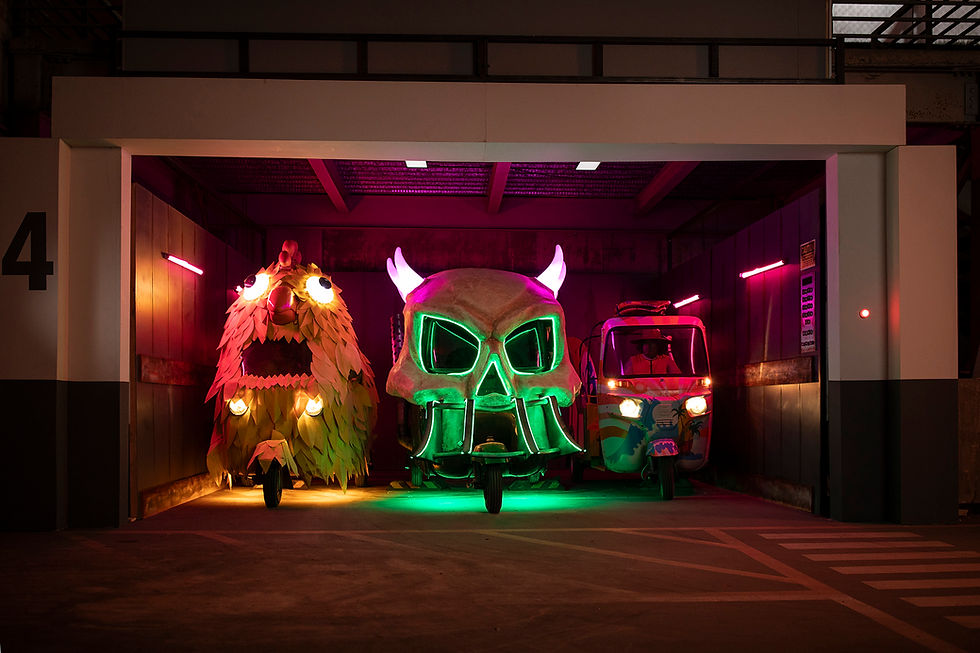
However, “El correcaminos” embraces its absurdities in order to move forward. Not only that, but we are also witnessing the best use of product placement in Peruvian cinema. Other filmmakers forcefully insert a Radio X billboard or set an entire scene in Supermarket Y with forced, awkward dialogue. Under the pretext of racing, we see real advertisements, one after another, but ingeniously incorporated as an entertaining part of the script—and they are not annoying at all.
Jesús (Emanuel Soriano) is a young man who is fascinated by motorcycle taxi races on the circuit in the hills of Chorrillos, in southern Lima. His ambition to compete in national races is cut short, and a decade later, now a mechanic, he has the opportunity to return to racing thanks to an advertiser who will dress him up as a chicken and use a motorcycle taxi with a chicken exterior to promote his poultry shop. In passing, he will be able to avenge his old enmity with the villain of the competition, nicknamed El Tunche (Óscar Meza), who also has his eyes on the beautiful July and has two thugs who do his dirty work. To achieve his goals, Jesús, now nicknamed “El Pollito,” will have the support of his brother Ramón (Junior Silva). The “roadrunner” part will be explained later.
Elliott, in an interview I did with him, was very clear in pointing out that he didn't come up

with all the ideas. The idea for the shape of the motorcycle taxis and all the characters in the competitions wasn't his. But the tone achieved is very refreshing, where his foreign gaze processes stereotypes and returns them in the form of runners with names like El Chinchano, El Venezolano, El Surferito, El Guerrero Moche, and others, without seeming offensive, but rather totally valid. His shameless use of artificial intelligence to introduce characters and save money on digital effects is also very entertaining. Like the mockery of congressmen, biofairs, or Emilram Cossio turned into a television presenter with the look of “Mad Max 3.”
Soriano is a more than competent actor who gives his Jesús a fragile charisma that is consistent with the circumstances and motivations around him. Palomino and he have a sparkling chemistry on screen that could have been better exploited; she has a role that borders on the archetype of a Manic Pixie Dream Girl (a fantasy girl, attractive and dedicated to supporting the male character no matter what and without any real explanation as to why) but, again, in the tone of family, neighborhood, and middle-class struggle in which things are presented, it is well disguised.

The best character, without a doubt, is Óscar Meza as El Tunche. Exaggerated, excessive, ridiculous, and eccentric, he even deserves his own movie. Especially since Elliott composes his humor with elements of Anglo-Saxon comedy in the style of “Austin Powers,” with moments of absurd phrases and prolonged awkward silences (“okkk...,” “right...”) and you feel his need to explore more in that direction. There are also inexplicable details, such as introducing Jesús as “Jesús Rodríguez Rodríguez de Rodríguez,” or the notes of old-fashioned, basic humor à la Risas y Salsas, such as saying “Chat GPT, bividí, pipiripipí,” or something like that.
Of everything I saw in “El correcaminos,” two moments stand out: one, the spectacular race in an abandoned shipyard (a magnificent location find!) and the sensational “Chicha-Tron” sequence, which is exactly what the name says: a chicha-style race in the style of “Tron.” Elliott, trained in advertising, shows off his knowledge of camera work, lighting, and digital work throughout the film, but it is here that he reaches his climax (although the jump scene has its own appeal). The fact that his film was released in the same year as the new film “Tron: Ares” is a coincidence, he told me. What is no coincidence is the novelty of having films like this on the big screen, because it has taken a lot for Peruvian cinema to reach this point. Now it's time to enjoy it.
Year of Release: | 2025 |
Director | Barney Elliott |
Producer | Ernesto Gonzalez Quattrini |
Cast | Emanuel Soriano, Junior Silva, Oscar Meza |
IMDB |


Comments