


Ramón & Ramón
Updated: May 13
RATING: 3.5/5 | By Sandro Mairata @smairata/ REFLEKTOR
“An ‘emotional road movie’ where masculinity is put to the test”

In Ramón & Ramón, Salvador del Solar offers an intimate melodrama of grief, filiation, and male desire set against the backdrop of the pandemic, but he frames it in such a conventional dramatic device that it ends up diminishing much of its power. The film seems to waver between a delicate portrait of wounded subjectivity and the aspiration to create a sociocultural allegory of contemporary Peru, without fully embracing the risk that either of these paths would require.
What is most disconcerting is seeing the talented actress Jely Reátegui with her skin suspiciously darkened, playing an Andean woman who welcomes the central character of Emanuel Soriano, one of the Ramones of the title, who is her cousin, recently arrived from the capital with the urn of his father, the other Ramón in the story.
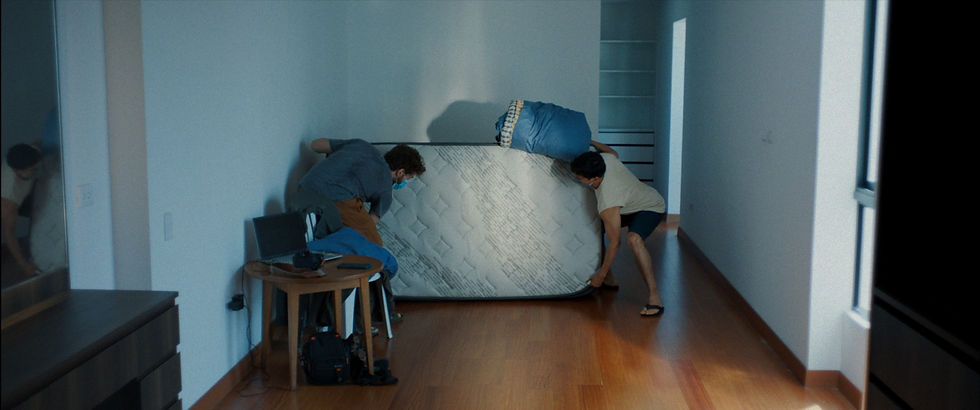
Ramón & Ramón, directed by talented actor, director and former Peruvian Prime Minister Salvador del Solar was co-written by the director hand in hand with another Peruvian director, the great Héctor Gálvez. It’s a story in two halves: in the first, Ramón (Soriano), a gay limeño suffering from the loneliness of pandemic quarantine in his apartment, seeks to seduce a Spaniard who has just arrived in his building named Mateo (Álvaro Cervantes), due to the rejection of his previous partner. In the second half, Ramón and Mateo travel to the village of Mito, in the mountains of Concepción, Junín, to leave the urn of Ramón's deceased father.

In Ricardo de Montreuil’s Mistura (2025), the Mexican stunner Bárbara Mori plays a wealthy limeña from the sixties, complete with a local accent from the time period. Why is there a problem with the choice of Reátegui for an Andean role? For a leading role, a director conducts an exhaustive search and finds the most suitable talent inside or outside a country. For this supporting role, there is plenty of talent in the Peruvian regions. Del Solar should have known better.
Nevertheless, Soriano is an efficient actor with a real ability to move an audience; Cervantes is a good counterpart, but the alternation with the subplots about the Huaconada dance may confuse the intentions and opens up paths that the script does not fully resolve. In any case, between the first and second halves, the second stands out so much that the first could easily have been dispensed with, which from this perspective—the COVID issue ends up not mattering too much—becomes completely unnecessary.
The central dramatic device—two men accompanying each other on a physical and emotional journey linked to the death of their father—places Ramón & Ramón, in a genealogy of “emotional road movie” stories where masculinity is put to the test. Del Solar opts for an explicit queer sensibility, not so much through the representation of desire as through the staging of verbal intimacy, whispered confidences, and shared silences. The film thus occupies an interesting space: it neither conceals Ramón's gayness nor makes sexual orientation the melodramatic focus of his suffering; the primary wound is that of the severed paternal bond and the feeling of not having been seen or recognized.
Year of Release: | 2025 |
Director | Salvador del Solar |
Producer | Agustín Almodóvar Marcela Ávalos Carolina Erazo Esther García Nicolás Valdés Miguel Valladares Diego Vives |
Cast | Emanuel Soriano, Álvaro Cervantes |
IMDB |


Comments